Veliki Tabor on the Eve and in the Course World War II
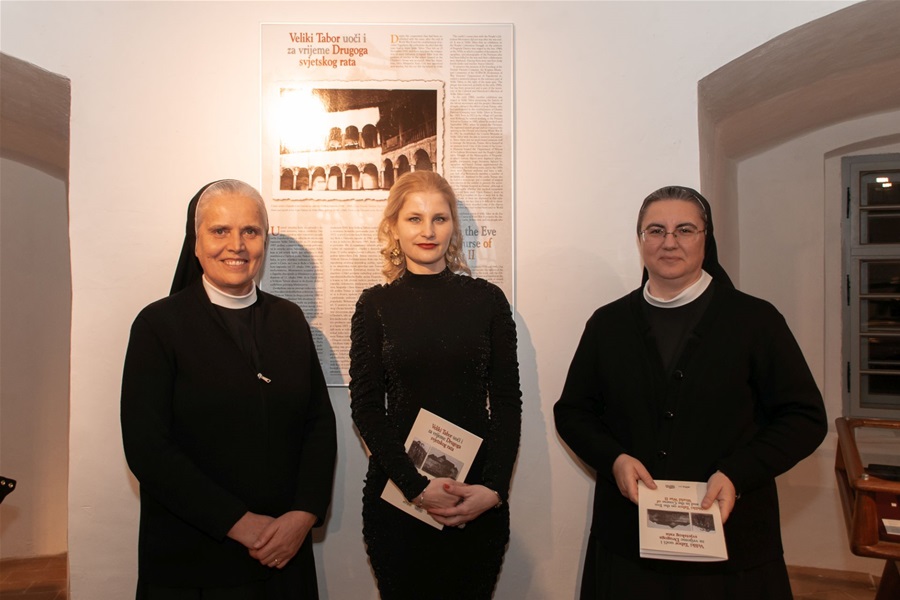
On Friday, December 8, 2023, the Veliki Tabor Castle hosted the grand opening of the exhibition Veliki Tabor on the Eve and in the Course World War II by Renata Dečman, Senior Curator and Head of the Museum.
At the very beginning of the ceremony, Renata Dečman greeted everyone present and introduced the exhibition, which presents the history of the castle, its purpose and users from 1938 to 1945. She explained that this was the period when Veliki Tabor was managed by the nuns of the Congregation of the Daughters of Charity of the Third Order of St. Francis from Blato on Korčula. They moved into the castle in August 1938, soon after the state bought it from its previous owner, Tomislav Iveković (son of the famous painter Oton Iveković), and they lived there until November 1945. After their arrival, Veliki Tabor began to be used as a summer camp, and nuns took care of children who came for a one- or two-month stay. During World War II, the castle housed a state children's home, and nuns took care of war orphans. By decision of the Ministry of Education of the Independent State of Croatia, a four-grade elementary school was opened in Veliki Tabor in August 1944, under the administration of the school in Desinić. Dečman then pointed out that the castle also became a scene of activity for fighters of the National Liberation War because partisans moved and operated in its immediate vicinity, and they often used the interior of the castle. The Desinić Partisan Company was founded here on November 2, 1943, and from the testimonies of the participants in the events, it is known that partisans went to Veliki Tabor to rest and recover from battles. As far as is known, the Partisans also used the castle for secret meetings and to store military supplies, and when they firmly held Desinić in their hands in the first half of 1944, they took over the care of war orphans and nuns. The author of the exhibition then introduced the attendees to the exhibitions that opened in Veliki Tabor soon after the end of World War II, presenting the People's Liberation Struggle in the Pregrada district.
Sr. M. Mirjam Gadža, provincial superior of the Daughters of Mercy of the Third Monastic Order of St. Francis in Zagreb, also addressed the attendees with a few appropriate words, who officially declared the exhibition open.
The attendees had the opportunity to see 40 exhibits. They viewed postcards, photographs, magazines, books, weapons, military and medical equipment, a memorial plaque, as well as other objects (such as children's shoes) that testify to life in Veliki Tabor during that period.
This exhibition also presented the results of research conducted by the author of the exhibition at the Croatian State Archives in Zagreb, so guests saw reproductions of photographs and various documents, such as cost estimates and descriptions of the works carried out during the renovation of Veliki Tabor, on panels in English and Croatian, as well as in a video presentation.
The event was complemented by an excellent musical performance by the "Đuro Prejac" Choir from Desinić.
All interested parties will be able to view the exhibition until December 8, 2024.
Photo gallery